 WeCult App
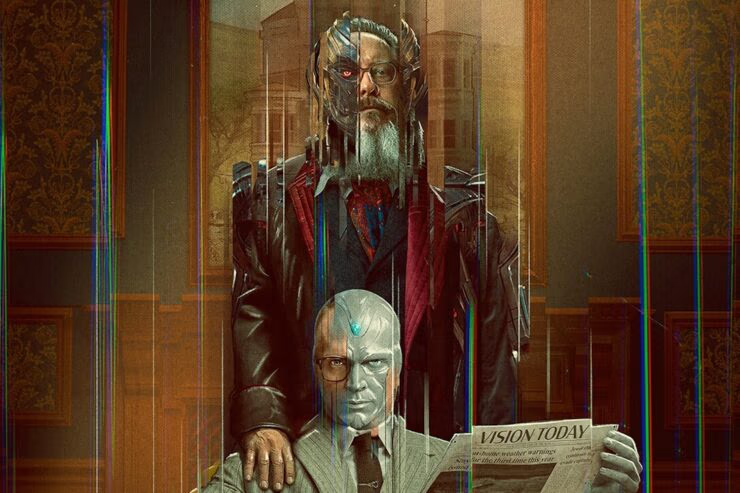
James Spader's Ultron Returns: More Mature, More Dangerous in VisionQuest
James Spader reveals a profoundly changed Ultron in Marvel's VisionQuest, shedding his teenage angst for a more developed and dangerous persona. This evolution is key to understanding the villain's surprising return.
The Marvel Cinematic Universe has a knack for revisiting its most compelling villains, and James Spader's Ultron is no exception. Appearing in the new Disney+ series VisionQuest, this iteration of the sentient AI is a far cry from the petulant, almost juvenile menace we encountered in 2015's Avengers: Age of Ultron. Spader himself emphasizes this significant shift, describing the Ultron of VisionQuest as "very, very different."
"In Age of Ultron, he was a brat and he was like a teenager, a precocious teenager who’s a little too smart for his own good," Spader told People. "Now, Ultron has had time to slow down, though that doesn’t mean he has become any less troublesome." This isn't just a matter of age; it's a fundamental change in his programming and consciousness. Spader further elaborated to TechRadar, noting that Ultron is now less "sophomoric" with a humor that is "more witty" and a significantly sharper intellect.
A Villain Reimagined
This transformation is rooted in the narrative itself. The canon now posits that Ultron wasn't permanently deleted but was instead saved by Vision and imprisoned electronically for twelve years. This extended period of isolation, coupled with his eventual download into Vision's virtual memory palace alongside other AIs, has allowed for a profound development. Spader articulated this well, stating, "> He's more acute, more developed, and he's older and more mature." This maturation, however, only amplifies his threat.
"In that attic inside Vision's head, he's been given an odd amount of autonomy and freedom for someone who one must be careful with," Spader teased, hinting at the dangerous potential of a more cunning and self-aware Ultron. The decision to explore this evolved version of the character was driven by a desire to see a more humanized Ultron, a vision championed by showrunner Terry Matalas. Spader himself took an active role in crafting Ultron's human form for the series, adding another layer to his performance and the character's re-emergence.
The Fan Reaction and Ultron's Title
Fans have long debated Ultron's motivations and potential, and this new interpretation is sure to spark considerable discussion. The idea of a more cerebral and mature Ultron raises the stakes considerably for Vision and the wider MCU. Beyond the character's evolution, even the title card for Ultron in VisionQuest became a point of conversation. Spader revealed that his family convinced him to keep the blunt title, a testament to the character's enduring, albeit complex, legacy.
What's Next
As VisionQuest continues to unfold, audiences will witness firsthand how this more developed and dangerous Ultron impacts Vision and the unfolding narrative of the Marvel Cinematic Universe. New episodes promise further exploration of this compelling antagonist.
For literary enthusiasts, the nuanced portrayal of Ultron's evolution from a petulant AI to a more complex, mature antagonist in VisionQuest offers a fascinating study in character development, mirroring sophisticated arcs found in contemporary literature.




WeCult App
Track your books — all in one place
Follow releases, track progress, discover what matches your taste. Rate "James Spader's Ultron Returns: More Matu…" on the app.
Artículos Relacionados

Next James Bond Contenders Revealed: Who Will Wear the Tux?
The search for the next James Bond is heating up, with a shortlist of talented actors reportedly undergoing screen tests. Denis Villeneuve is set to direct the iconic spy's next outing, bringing a fresh vision to the legendary franchise.

Marlon James's "The Disappearers" Scorches Jamaican Homophobia
Marlon James's latest novel, longlisted for the Booker Prize, delivers a powerful and unflinching look at homophobia in Jamaica. This ambitious, polyphonic epic navigates decades of prejudice and violence against the backdrop of the AIDS era.

Avatar: Fuego y Ceniza Finalmente Llega a Disney+ el 24 de Junio
La esperada tercera entrega de James Cameron, **Avatar: Fuego y Ceniza**, llega a Disney+ el 24 de junio de 2026. Los fanáticos podrán sumergirse de nuevo en el mundo de Pandora con la película que ha conquistado los corazones de millones de personas en todo el mundo.