 WeCult App
The Odyssey: Who Are the Mysterious Sea People in Nolan's Epic?
Christopher Nolan's ambitious take on **The Odyssey** introduces a chilling new threat: the enigmatic 'Sea People.' These shadowy figures loom larger than any mythical beast, but their true identity is rooted in a historical cataclysm.
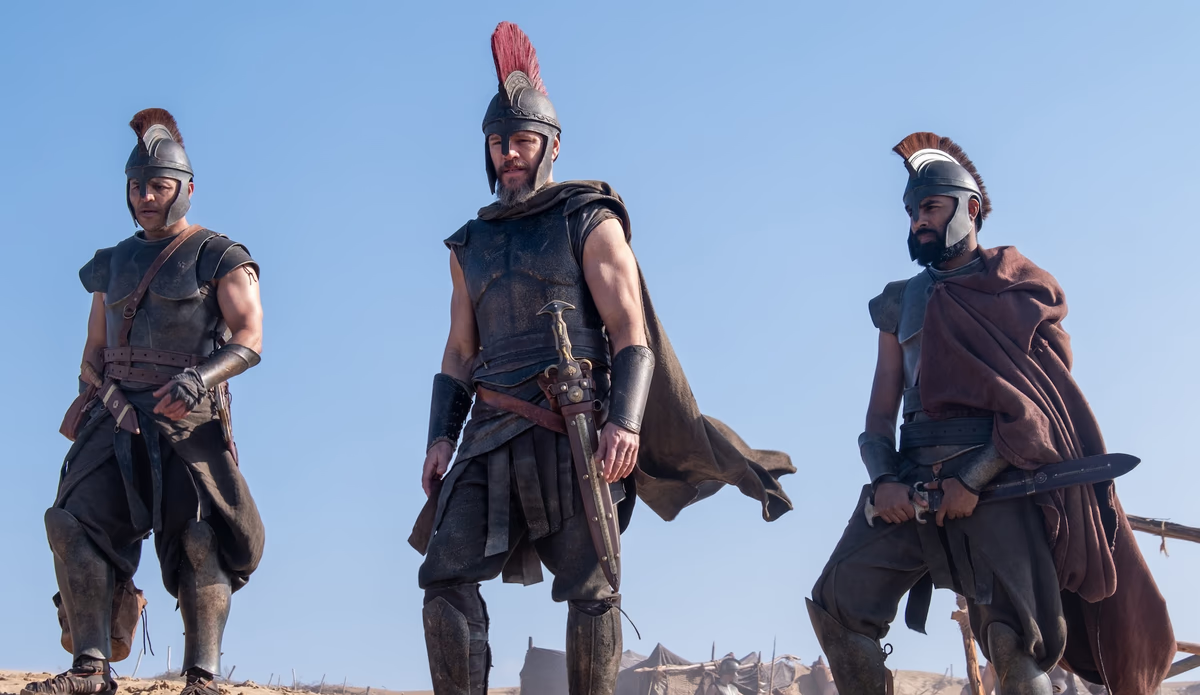
Christopher Nolan's The Odyssey plunges audiences into a world of gods and monsters, but one of its most terrifying antagonists isn't found in ancient myths. Instead, it's a pervasive whisper, a rumor of the Sea People that spreads like wildfire across the Aegean. These unknown invaders are presented as an existential threat, capable of bringing down entire civilizations, a danger far more potent than the sirens' song or the Cyclops's gaze. As the weary Odysseus, portrayed by Matt Damon, navigates his perilous journey home, he posits a chilling theory: the Sea People might not be strangers at all, but rather the very warriors returning from the Trojan War, including himself.
This innovation is a striking departure from Homer's epic, as the Sea People are not a figment of pure myth. They are drawn from the murky, fascinating history of the Late Bronze Age collapse. For centuries, historians and classicists have debated whether these enigmatic groups were the cause or merely a symptom of the widespread destruction that plunged the Mediterranean world into an era of darkness. Their impact was undeniable, spelling doom for powerful neighbors and leaving a legacy of ruin that echoes through time, a historical footnote with profound implications for the world Nolan presents.
The Bronze Age Collapse: A Real-World Nightmare
During the era depicted in The Odyssey, the city-state of Ugarit stood as a formidable coastal power in the eastern Mediterranean. Its prosperity, like that of many other Bronze Age centers, was ultimately shattered. The arrival of the Sea People, a confederation of diverse groups whose exact origins remain a subject of intense scholarly scrutiny, coincided with a period of widespread upheaval. Invasions, internal strife, and environmental factors likely contributed to a cascade of collapses, leaving behind a fragmented landscape and lost knowledge. The fear and uncertainty surrounding these events would have been palpable, a perfect narrative engine for Nolan to weave into his adaptation, making the abstract threat of societal collapse intensely personal for Odysseus.
A Mirror to the Returning Warriors
Nolan's decision to link the Sea People to the returning Greek warriors is a stroke of narrative genius. It transforms the mythic journey into a reflection of contemporary anxieties. The very soldiers who fought valiantly at Troy, returning home weary and perhaps changed by their experiences, could be perceived as a disruptive force by those who remained. Their arrival, coupled with the existing societal fragilities, could indeed destabilize the established order. This interpretation adds layers of complexity, suggesting that the greatest threats to civilization often come not from external monsters, but from the unintended consequences of our own actions and the cycles of violence we perpetuate.
What's Next
As The Odyssey continues to captivate audiences, the mystery of the Sea People invites further exploration. The film's inventive approach to historical speculation promises to spark lively debates among fans about the nature of myth, history, and the enduring power of Christopher Nolan's cinematic vision.
Nolan's brilliant reimagining of **The Odyssey** cleverly ties a real historical mystery into the heart of Odysseus's journey, offering a potent commentary on civilization's fragility.




WeCult App
Track your films — all in one place
Follow releases, track progress, discover what matches your taste. Rate "The Odyssey: Who Are the Mysterious Sea …" on the app.
More Like This

Jenna Ortega Hopes 'Klara and the Sun' Urges Us to Unplug
Jenna Ortega's new dystopian film, Klara and the Sun, premiered at the London Film Festival. The actress hopes the movie encourages audiences to disconnect from technology and reconnect with each other.

John Leguizamo on 'The Odyssey,' Blind Roles, and a Spider-Man Snub
The prolific actor John Leguizamo opens up about his transformative role in 'The Odyssey' and a surprising exclusion from a major superhero film. His candid discussion sheds light on non-traditional casting and Hollywood's complex landscape.

Charlize Theron: 'The Odyssey' Reminds Hollywood of Epic Magic
Charlize Theron believes Christopher Nolan's latest epic, 'The Odyssey,' has delivered a vital message to Hollywood. The blockbuster is proving the enduring power of grand-scale storytelling.